Films
Films
Three 3D films made with PromptFilm. For each one: what it shows, which sources shaped the scenes, and which parts are illustrative.
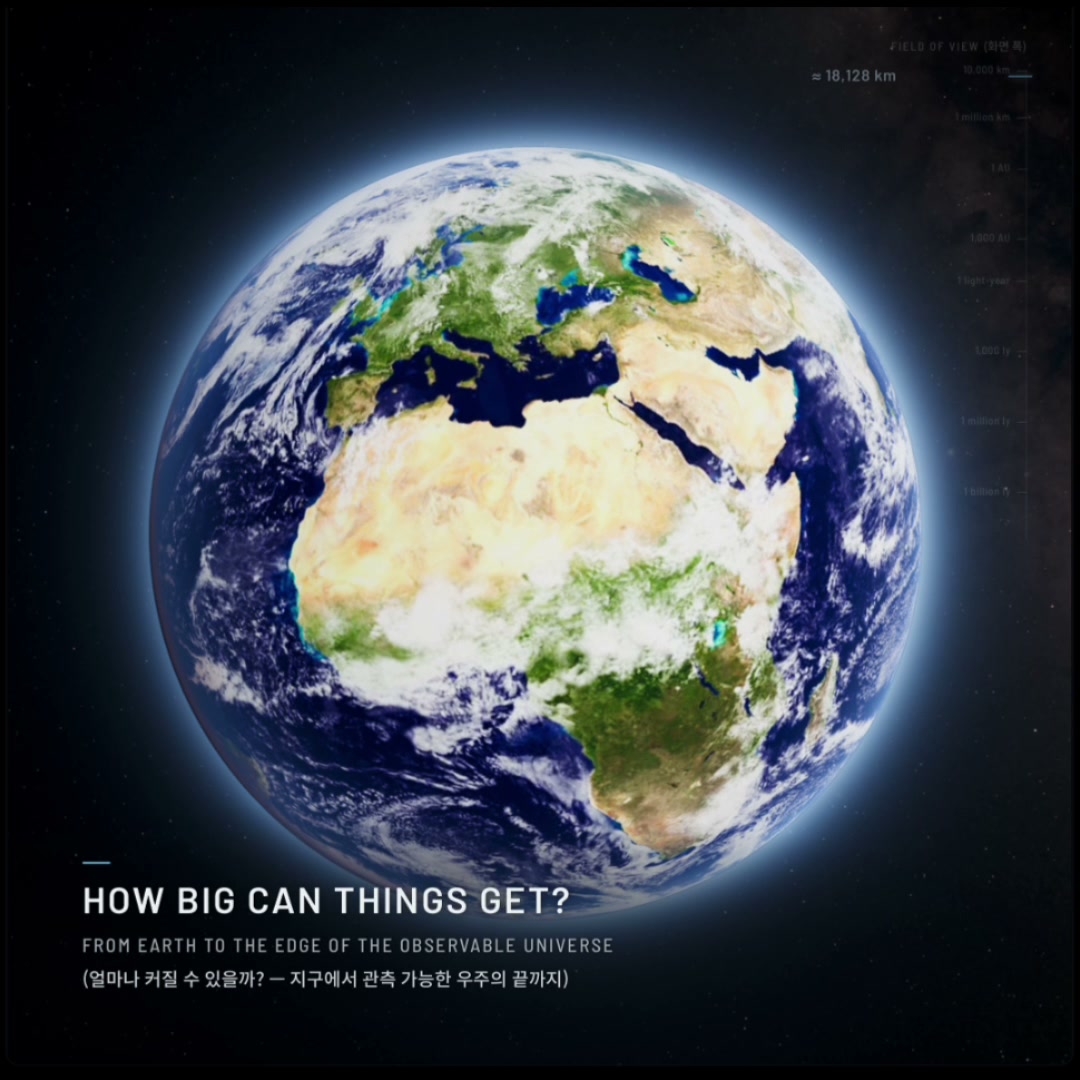
Cosmic Size Ladder
From Earth to the edge of the observable universe
What it shows
It answers “how big can things get?” by lining bodies up beside Earth at their true relative size. Starting from Earth, 12,742 km across, it passes Neptune, Uranus, Saturn and Jupiter, the exoplanets HD 189733 b and HAT-P-67 b, the Sun, then Sirius, Arcturus, Aldebaran, Rigel, Deneb, Betelgeuse and Antares, ending at VY Canis Majoris. Next to VY CMa, Earth takes up less than one pixel of a 1,000-pixel frame.
From there it stops comparing sizes and becomes a map of real positions: the Kuiper belt 30–50 AU from the Sun, the edge of the heliosphere the Voyagers crossed near 120 AU, the Oort cloud known only from comets, Proxima Centauri 4.24 light-years away, real star positions within 100 light-years, the Milky Way (about 100,000 light-years across), the Local Group, the Virgo Supercluster, Laniakea (about 520 million light-years) and the cosmic web. It ends at the observable universe, about 93 billion light-years across, then flies the same path back at true scale to the “pale blue dot.”
What the numbers come from
Planet sizes come from NASA fact sheets, the Sun from the IAU 2015 nominal radius, and exoplanets from papers listed in the NASA Exoplanet Archive. Stellar radii and temperatures come from individual measurements (for example Joyce et al. 2020 for Betelgeuse and Wittkowski et al. 2012 for VY CMa), and brightness is computed from them with the Stefan–Boltzmann law (luminosity ∝ radius² × temperature⁴). Nearby stars use the HYG catalogue, the Orion Spur follows maser parallaxes from Reid et al. (2019), and the Virgo Supercluster uses 2MRS galaxies.
What is illustrative
The captions say so on screen. Individual Kuiper belt objects, Deneb’s surface pattern, Laniakea’s flow lines and the Milky Way itself are models, not photographs. Planet Nine is labeled an undiscovered hypothesis and the Pisces–Cetus complex a proposed structure. The cosmic web is observed only within about a billion light-years and simulated beyond. The observable-universe scene closes by noting that the size of the whole universe is not known.
How it was made
I described the idea to PromptFilm, which then ran research, scene planning, 3D build and review, and MP4 export. Covering everything from Earth (about 10⁴ km) to the observable universe (about 10²³ km) in one scene breaks floating-point precision, so every frame rescales the whole universe to keep the camera the same distance from its subject (a floating origin). It is an HTML file that plays in the browser and needs WebGL 2.
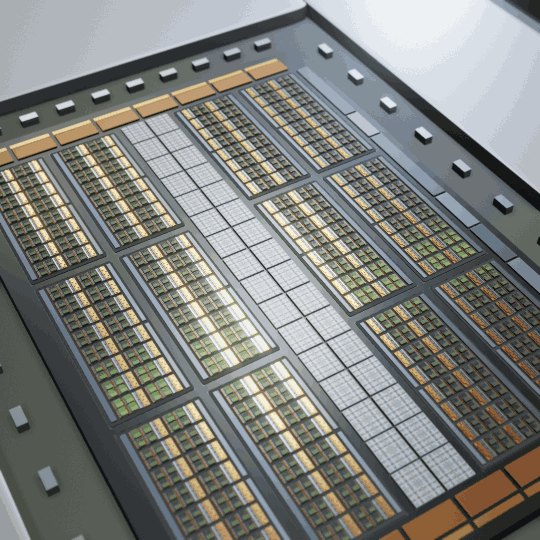
Blackwell
From the data center down to a single atom
What it shows
It zooms without a cut from a data center rack to a single RTX PRO 6000 Blackwell card, its GPU, the compute units inside, one transistor and finally silicon atoms. The zoom stops at the 0.235 nm spacing between atoms.
- Server and rack — a generic concept, not a specific NVIDIA system
- The card — RTX PRO 6000 Blackwell Workstation Edition, 96 GB GDDR7
- GB202 die — 92.2 billion transistors, 750 mm², TSMC 4N
- Full chip — 12 GPCs, 96 TPCs, 192 SMs, 128 MB L2 cache
- One SM — 128 CUDA cores, 4 Tensor Cores, 1 RT Core
- One processing block — 4 per SM, 32 CUDA cores, 64 KB register file
- Memory cell — six transistors holding one bit, and how it is read
- One CUDA core — the fused multiply-add unit, full-adder array and an XOR cell
- Transistor cross-section — the gate wrapping the fin, with current flowing beneath
- Silicon atoms — each bonded to four neighbours
What the numbers come from
The chip layout and figures follow NVIDIA’s published RTX Blackwell GPU architecture paper, with page numbers noted in the film’s code. Before playback, the code checks that the CUDA core count derived from GPCs, TPCs and SMs (24,576) matches the paper’s totals.
One inconsistency is left visible rather than smoothed over. The paper says the RTX PRO 6000 uses the full GB202, yet its spec table lists 188 SMs (24,064 CUDA cores). The film draws the full 192-SM chip and does not invent which SMs are disabled on retail cards.
What is illustrative
The chip diagram is a logical block layout, not a silicon floorplan. The card interior, the inside of a processing block, the electron-microscope views and the gate stack (SiO₂, HfO₂, TiN) show generic structures for explanation and are not NVIDIA’s actual 4N process. Each of those scenes is captioned “illustrative.”
How it was made
PromptFilm fixed the scene order and figures first, then the scenes were built in Three.js. A readout shows the real width of the current view so you always know the scale; in the CUDA core scene the frame is about as wide as a single hair.
New Element
Rebuilding the new-element scene from Iron Man 2
What it shows
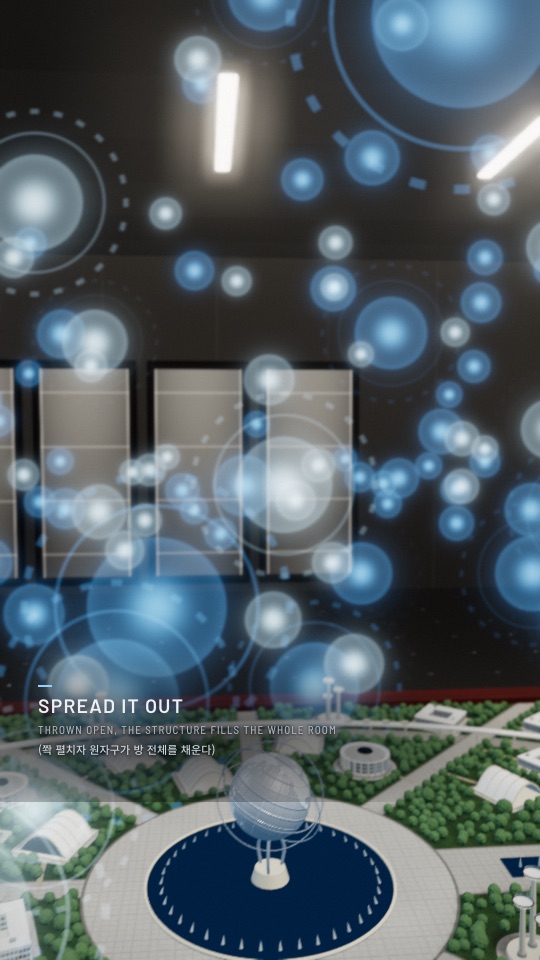
It rebuilds the scene from Iron Man 2 (2010) where Tony Stark finds a new element hidden in his father’s 1974 Stark Expo model, using only the structures and no characters. It follows the film’s idea that the Unisphere at the center, the radial avenues and the pavilions are laid out like a nucleus and its surroundings.
- The whole model is scanned into a digital wireframe.
- The copy lifts off, and removing trees, paths, pools and parking leaves only the pavilions.
- The Unisphere turns out to sit exactly where a nucleus would be.
- Each pavilion breaks down into protons and neutrons, which pack into one new nucleus.
- The room-sized structure is pressed between two palms into something small enough to hold.
The film and the real science
In the film, the palladium core (element 46) of the chest device is poisoning its wearer, and the new element arrives as its replacement. The film never gives an atomic number, and the nucleus in this video is only an example drawn with a chosen number of nucleons.
Real new elements are not made this way. Accelerators smash nuclei together and produce a handful of atoms at a time. Element 117 (now tennessine) was reported on April 9, 2010 by a team at JINR in Dubna, Russia, from six observed atoms, exactly four weeks before Iron Man 2’s US release on May 7, 2010. The video ends on that contrast.
What is illustrative
The model’s size and the layout of its 48 pavilions are estimates rebuilt from the film’s frames, not a copy of the original set. No characters or performances from the film are included.
How it was made
It is cut as a vertical 9:16 short. Each stretch of the timeline is tagged as a hook, key moment, progress, transit or return, and plays at a different speed: long moves where nothing new appears go fast, and the key reveal of the atomic structure slows down. Nucleon slots are computed first so they pack evenly, and each nucleon takes the free slot nearest its own direction so their flight paths do not tangle.